
You’re watching the wheel spin, seeing the number 1 come up for the fifth time in a row, and the question hits you: is the Mega Wheel rigged? It’s a common feeling for players on FAIRPLAY and other platforms, where the search for a predictable pattern can feel intense. The truth about this popular live game show isn’t found in lucky charms or betting systems, but in a direct analysis of its mechanics, probabilities, and the verified technology that drives it.
Understanding the Segment Layout
How segments are arranged and displayed on mobile
When you load the game on your phone, the first thing you see is the vibrant, 54-segment wheel dominating the screen. The numbers are not sequential. Instead, they are distributed to create a visually balanced and dynamic spinning effect. On a mobile interface, the betting grid is an overlay at the bottom, allowing you to place your wager in PHP without losing sight of the wheel. The key observation is the frequency of each number: the number ‘1’ appears on 20 segments, ‘2’ on 13 segments, and so on, with the high-value numbers ’30’ and ’40’ appearing on just one segment each. This distribution is the foundation of the game’s entire probability structure, not a random design choice.
The impact of segment size on game outcomes
The physical space each group of numbers occupies on the wheel directly corresponds to its probability. The 20 segments for the number ‘1’ take up a significant portion of the wheel’s circumference, making it the most likely outcome. In contrast, the single segment for the number ’40’ is a tiny sliver. This isn’t a “bias” in the sense of unfairness; it’s a deliberate design that balances risk and reward. The game is engineered so that frequent, low-payout results subsidize the rare, high-payout ones. Understanding this visual math is the first step to moving away from the idea of patterns and towards a strategy based on statistical reality.
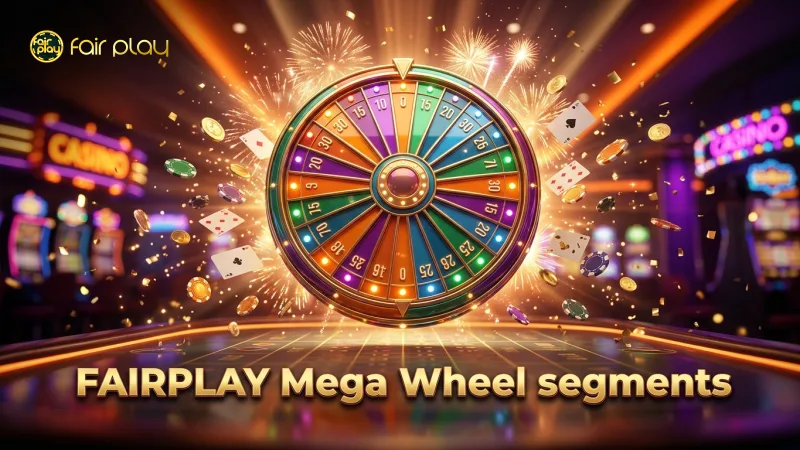
Detailed view of Mega Wheel’s segment distribution on mobile.
Probability and Multipliers Behind Each Mega Wheel Segment
Developer-disclosed RTP and segment odds
Game provider Pragmatic Play is transparent about the math. The game operates with a stated optimal Return to Player (RTP) of 96.51%. This is a long-term theoretical average, not a guarantee for any single session. The probability of hitting each number is a direct function of how many segments it has. Your chance of winning on any given spin can be calculated before the host even touches the wheel.
The core probabilities are straightforward. While live game shows can feel more unpredictable than slots, some, like MONOPOLY Live, build complexity through multi-stage bonus rounds. Mega Wheel, by contrast, keeps its core probability on the main wheel itself.
| Number/Segment | Number of Segments | Payout | Probability of Hitting |
|---|---|---|---|
| 1 | 20 | 1:1 | 37.04% |
| 2 | 13 | 2:1 | 24.07% |
| 5 | 7 | 5:1 | 12.96% |
| 8 | 4 | 8:1 | 7.41% |
| 10 | 4 | 10:1 | 7.41% |
| 15 | 2 | 15:1 | 3.70% |
| 20 | 2 | 20:1 | 3.70% |
| 30 | 1 | 30:1 | 1.85% |
| 40 | 1 | 40:1 | 1.85% |
Why high multipliers have lower probabilities
The table above makes it clear: the higher the payout, the lower the probability. This is the fundamental trade-off in any game of chance. Landing on the ’40’ segment has a raw chance of 1-in-54. The real excitement, the ‘Mega’ part of the name, comes from the pre-spin multiplier. Before each spin, a Random Number Generator (RNG) selects one number and assigns it a special multiplier, up to 500x. This bonus adds a layer of variance but does not change the base probability of the wheel stopping on a specific segment. Hitting a 500x on the number ’20’ requires two statistically independent events to happen: the RNG must first select ’20’ for the multiplier, and then the physical wheel must land on one of the two ’20’ segments. This makes it a very rare, but very rewarding, event. For a related breakdown in the same category, Monopoly Live Myths Rolls is worth a read as well.
Probability chart showing segment multipliers and odds.
Evaluating Bias: Is the Wheel Truly Fair?
Common misconceptions about segment bias
The most common error in player thinking is the gambler’s fallacy—the belief that past outcomes influence future ones. If the wheel lands on ‘1’ five times, a player might feel a ’10’ or ’20’ is “due.” This is incorrect. Each spin is a completely independent event. The wheel has no memory. A professionally balanced and maintained wheel, as used in licensed studios, is engineered to produce random results. The history tracker is a record, not a prediction tool. Many players search for a Mega Wheel biased pattern, but the genuine “pattern” is the fixed mathematical probability that governs every single spin.
Mobile interface factors influencing player perception
Playing on a phone can distort your perception of the game. The small, focused screen, combined with the prominent display of past results, encourages you to look for trends. When you see a long list of low numbers, your brain is wired to expect a change, a reversion to the mean. In reality, a sequence of 20 ‘1’s or ‘2’s is just as statistically possible as any other specific sequence of 20 outcomes. The interface isn’t misleading you; it’s presenting raw data that players often misinterpret through the lens of cognitive biases. A stable stream without lag is essential, because any technical hiccup can be incorrectly perceived as manipulation.
Live Host Interaction and Mobile Experience
How live hosts affect player trust and engagement
The live host is a critical element of the game show experience, but they have zero control over the outcome. Their role is to provide entertainment, build community through the live chat, and announce the results. A professional and engaging host builds trust not by influencing the game, but by creating a transparent and enjoyable atmosphere. They are reacting to the same random outcome as you are. Their genuine excitement when a 500x multiplier hits is a testament to the rarity and thrill of the event. It proves they are watching a fair game, not executing a script.
Mobile responsiveness and smooth gameplay considerations
For a game of chance to feel fair, the technical delivery must be flawless. A choppy video feed, a delayed betting interface, or a game that crashes on your phone can instantly create suspicion. Our team at FAIRPLAY understands that a robust, high-speed connection to the provider’s studio is non-negotiable. The gameplay should be smooth, with bets actioned in real-time and results displayed instantly. The pace of Mega Wheel is quite steady, but if you’re looking for something much faster, the mechanics of Speed Baccarat offer a different kind of thrill based on rapid, successive rounds. In either case, the technical integrity must be perfect.

Mobile gameplay with a live host enhancing FAIRPLAY trust.
Responsible Gaming: Managing Expectations
Recognizing the low chances of hitting big multipliers
It is absolutely vital to approach this game with realistic expectations. The possibility of turning a PHP 100 bet into a PHP 50,000 payout is what makes the game exciting, but you must recognize it as a low-probability event. The majority of spins will result in ‘1’s and ‘2’s, which often means small wins or break-even results. The game is designed for entertainment. Never chase losses or bet more than you have budgeted for entertainment, assuming that a big win is statistically overdue. Adults aged 18 and over should play with funds they are fully prepared to lose.
Using e-wallets like GCash and Maya for safe betting
One of the most effective tools for responsible gaming is right on your phone: your e-wallet. Using GCash or Maya to fund your FAIRPLAY account is a sound strategy. Before you play, decide on a strict session budget—say, PHP 1,000. Cash-in exactly that amount and no more. This creates a hard stop. Once that amount is gone, your session is over. This method prevents you from dipping into other funds in the heat of the moment. It makes cashing out your winnings just as direct and keeps your gaming funds separate from your daily expenses—a cornerstone of smart bankroll management.
PAGCOR licensing and what it means for fairness
A PAGCOR license is your most important assurance of fairness. This is not just a piece of paper. It signifies that the operator is held to strict standards of conduct and that the games offered are from vetted, internationally recognized providers like Pragmatic Play. The game providers themselves are subject to regular, independent audits of their Random Number Generators and live studio operations. PAGCOR’s oversight ensures that the mathematical models (like the 96.51% RTP) are accurate and that the physical equipment is calibrated for true randomness. It’s a verified seal that a thumb is not on the scale.
The only “pattern” in Mega Wheel is its mathematical design. Instead of looking for secrets in the spin history, focus on managing your betting unit size and enjoying the show for what it is—a visually exciting game of chance with transparent, albeit low, odds for a massive payday.
